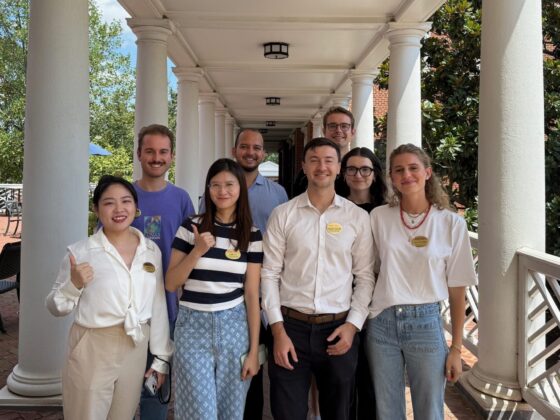
Tristan is a Part-Time MBA (Class of 2028) student at Darden and a Senior Consultant at IBM, where he focuses on energy development, capital deployment and operating model transformation. At Darden, he is a ROMBA Scholar and serves as Class President. Following graduation, he hopes to move to New York City to pursue a role that combines strategy and finance in private equity, mergers and acquisitions and energy. Prior to Darden, Tristan earned his undergraduate degree from the University of Virginia, where he participated in student government and competed on the varsity swimming and diving team. He later earned a master’s degree in Sustainability Management from Georgetown University’s McDonough School of Business, where he also swam competitively.
Over fall break, Tristan participated in the Argentina Global Residency, where he spent a week immersed in the business and local cultures of Buenos Aires and Mendoza. Read his reflections on a company site visit to a local winery and key takeaways about business, leadership and culture from his time in Argentina below.
A DAY AT ZUCCARDI FAMILY WINES
About 45 minutes outside Mendoza, past rows of vines that look improbable in a desert, we spent a day with José Alberto Zuccardi. His father founded Zuccardi Family Wines in 1963, and José Alberto joined in 1976. What began as an idea about irrigation – how to get water to vines and olive trees in one of Argentina’s driest regions – now grew into something far bigger than anyone in the family imagined.
Today, Zuccardi is a benchmark in Argentina and abroad, producing some of the finest wines in the Southern Hemisphere. José Alberto credits his son Sebastián, whose mission is to make wines that express the distinct terroirs of the Uco Valley. With his children Julia and Miguel, he has grown the business into tourism and extra virgin olive oils that have earned international recognition. Each generation, he told us, was learning for the first time.
We walked past the vats where the wine ages, through the olive groves and into production, and watched the family work and talk with one another. We tasted their olive oils side by side and learned how each is made, what it’s for and how it traces back to the family’s roots. Then came the wine: a beautiful orange wine, and a red they have spent years perfecting that is now one of the most popular in the region.
None of it came easily. José Alberto described challenges: scarce rain in a desert, inflation swings, tariffs, new entrants, climate change and a world that is simply drinking less wine, which squeezes exports. We had studied every one of those forces through the case method. Hearing how a family faced them in real time, with little room for error and with families and a community depending on them, was entirely different.
What stayed with me most was the feeling of the place. This was not about hitting a revenue target or launching the next product line – it was a family, there for each other, sharing a passion and pride that everyone owned. The rest seemed to follow from that.

WHAT SURPRISED ME FROM MY TIME IN ARGENTINA
Not every net present value (NPV) has to be a number. We spend a lot of time at Darden discounting cash flows, and financial return matters. But at Zuccardi, the value being created also showed up as fulfillment, customer delight, healthier land, and a community that holds together. Sometimes the most impressive NPVs aren’t financial at all. José Alberto Zuccard told us, “Profitability is like breathing. We need it to function, but it’s not something we should be thinking about constantly”.

HOW THE EXPERIENCE BROADENED MY THINKING
Business
The most striking lesson on the business side was how adaptable Argentine companies must be. Plans that a U.S. firm might set once a year are revisited constantly as managers navigate inflation, currency swings and shifting trade relationships with neighboring economies. Family businesses and large corporations alike build flexibility into every decision, because the ground beneath them keeps moving.
That volatility sits alongside real opportunity. I was surprised by how many emerging markets and underserved segments exist for new and growing businesses. Yet I also saw how quickly elections, policy changes and industry moves, both at home and across the region, can reshape the case for an investment or an expansion, whether the company is a multinational or a family winery.
The course challenged an assumption I didn’t know I had held. As an American, I have only ever had to think about producing, selling and trading in U.S. dollars. Speaking with locals made clear how much harder decisions become when you must separate nominal from real rates in an economy where both are constantly moving and difficult to forecast. Modeling inflation in a spreadsheet is one thing; running a business through it is another. I now understand why macroeconomic stability and development matter far more to everyday business decisions than I had appreciated.
Leadership
On the leadership side, our visit to the seed company GDM stood out. We met with CEO Ignacio Bartolomé, who described his team’s role as safeguarding the company’s stability and sustainable growth: protecting its resources, promoting transparency and giving the organization the strategic support it needs to keep expanding on a global scale. For a company with worldwide ambitions, that emphasis on strong foundations over quick wins was telling.
What impressed me most was the care GDM shows for every person and every business unit. Two of its guiding priorities, human development and transparency and compliance, commit the company to the growth and well-being of its teams and communities, and to acting with ethics and integrity in all its operations. Just as important, GDM turns those values into a system that sets priorities and drives action across the organization. That is what I want to carry forward as a leader: values make the biggest difference when they are built into how decisions get made, not simply stated.
Culture
An Argentine expression that captures the business culture is atado con alambre, literally “tied together with wire”: the knack for finding a creative fix with whatever resources are on hand. Decades of economic swings have turned that resourcefulness into a competitive advantage, as teams improvise, rework plans quickly and treat constraints as a starting point rather than a stopping point. It sharpened how I approach problems as a consultant, reminding me that the best solution is not always the most resourced one but the one that keeps the business moving.

WHAT I TOOK BACK WITH ME TO DARDEN
Argentina showed me that every valuation rests on assumptions about people, culture and context, and those assumptions are where the real judgment lives.
That has changed how I think about the work I want to do in private equity strategy and M&A. Underwriting a deal in Mendoza means separating nominal from real cash flows, pricing currency and country risk into the discount rate, and stress-testing a plan against an election cycle. Yet the most durable sources of value I saw were harder to model: a founding family’s pride in its product, a CEO at GDM who builds human development into how the company sets priorities, and teams resourceful enough to keep operating when conditions change overnight. In a deal, those are the factors that decide whether a value creation plan holds up after closing.
Back in the classroom, I now read cases differently. When a family business weighs a sale or a company enters a volatile market, my first question is no longer only “what’s the IRR?” but “what is this company’s culture, who sustains it, and will it survive the transaction?” Succession, leadership depth and integration risk have moved from footnotes to the center of how I evaluate an opportunity.
Moving forward, I want to be the kind of investor and advisor who can build a rigorous model and also understand what sits behind every line of it. The most impressive returns I saw in Argentina were not only financial, and I suspect the best deals are the ones that respect that.